
Your First Time in
Sicily, Italy
Sicily gave us a day of two halves that could not have been more different.
We docked in Messina on a cruise and took a tour that paired the two things most people come to this part of Sicily for: Mount Etna, the largest active volcano in Europe, and Taormina, the cliffside resort town that looks exactly like the Italian coast of your imagination. On paper, the volcano is the headline and the town is the supporting act. For us, it was the other way around.
Etna underwhelmed me, and I would rather tell you that than pretend otherwise. Taormina did the opposite. It delivered the postcard so completely it almost felt staged, in the best possible way.
One half of this day is a rugged, strange, high-altitude landscape that may or may not land for you. The other half is the Sicily you have pictured your whole life. Knowing which is which going in means you can spend your energy and your expectations where they actually pay off.
A half day covers both as a cruise excursion, which is how we did it. It is a lot of driving for the time you get on the ground, but the two stops together give you a real taste of a region that deserves far more than a day.
What to See on Your Visit to Sicily
Mount Etna and the Silvestri Craters
Mount Etna is the largest active volcano in Europe, and the tour takes you up to the Silvestri Craters at around 6,000 feet, where you walk the rim of craters from past eruptions. This is the headline of the day, and I want to be honest about what it actually is, because the word volcano sets an expectation that the reality does not quite meet.
The drive up felt rushed, winding through countryside and past villages before climbing into the higher, stranger landscape. We made a brief stop at a mountain restaurant, Ristorante Cantoniera, for the bathroom and a hot chocolate and a snack, all of which was forgettable. Then we got out and explored.
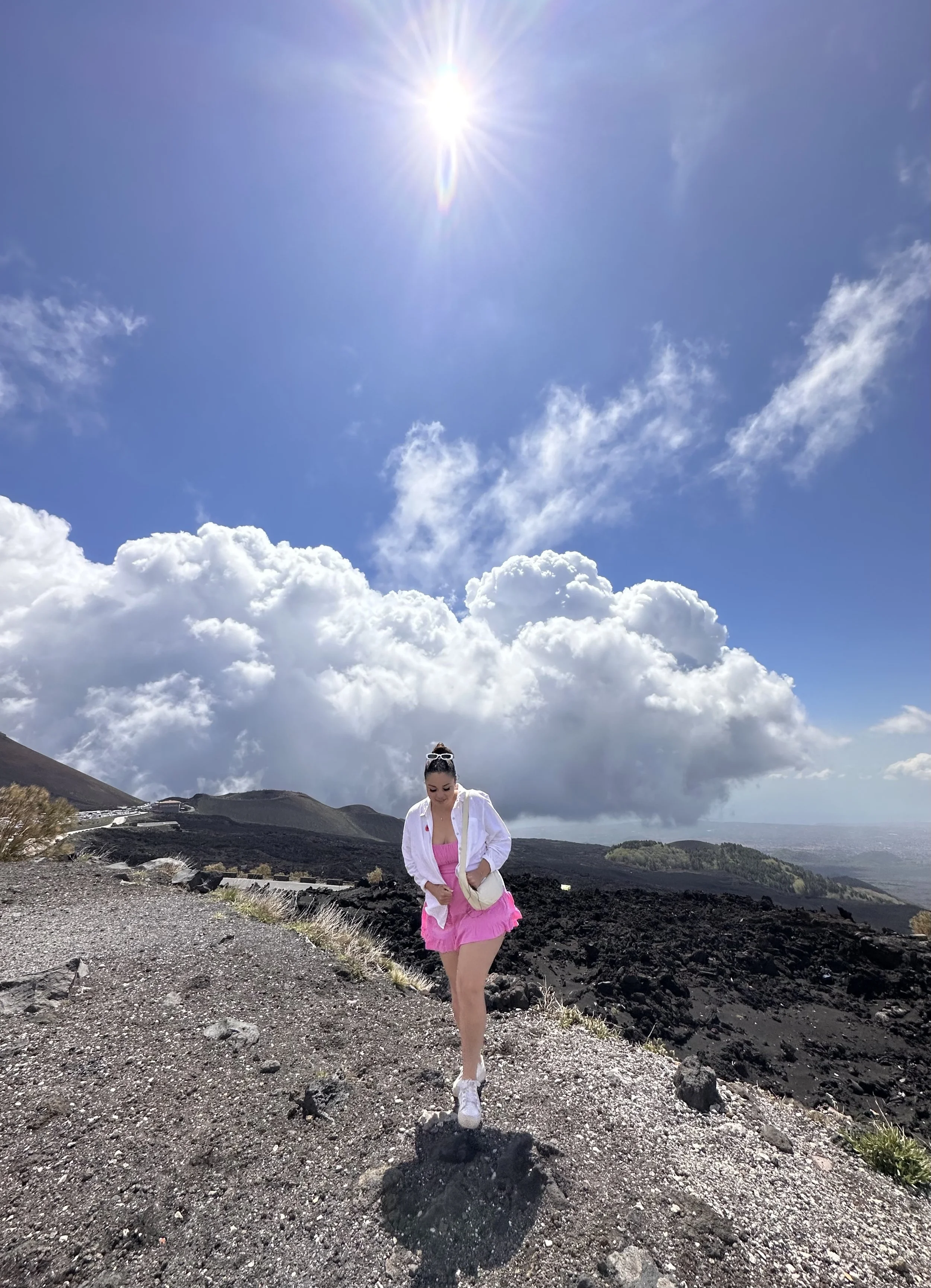
It was windy in a way that became the defining feeling of being up there, a constant, cold wind with nothing to break it, and the ground beneath us was black and bare. And here is the thing I did not expect: it did not really feel like a volcano. It felt like hiking a mountain in the aftermath of a forest fire, everything scorched and stripped down to rock and scoured by the wind. What saved it was the contrast. The black ground against a deep blue sky with white clouds moving fast overhead was genuinely beautiful, in a stark, alien way. Higher up, near the crater, the ground turned red in places and stayed black in others. But there was not much to actually look at. It was, honestly, mountains and rock.
I am not telling you to skip it. Standing 6,000 feet up on an active volcano is worth doing once, and if the weather is clear the views are reportedly spectacular. But go in understanding that this is a rugged, elemental landscape, not a dramatic smoking crater out of a movie. Manage the expectation and you will enjoy it more than I did walking in cold.
Taormina
Taormina is the other half of the day and it is the half that delivered completely.
Getting there tested our patience. The traffic into town was heavy, and at one point the road narrowed to a small two-way bridge that a tour bus could not cross at the same time as oncoming cars, which backed everything up considerably. Worth knowing so you are not surprised by it.
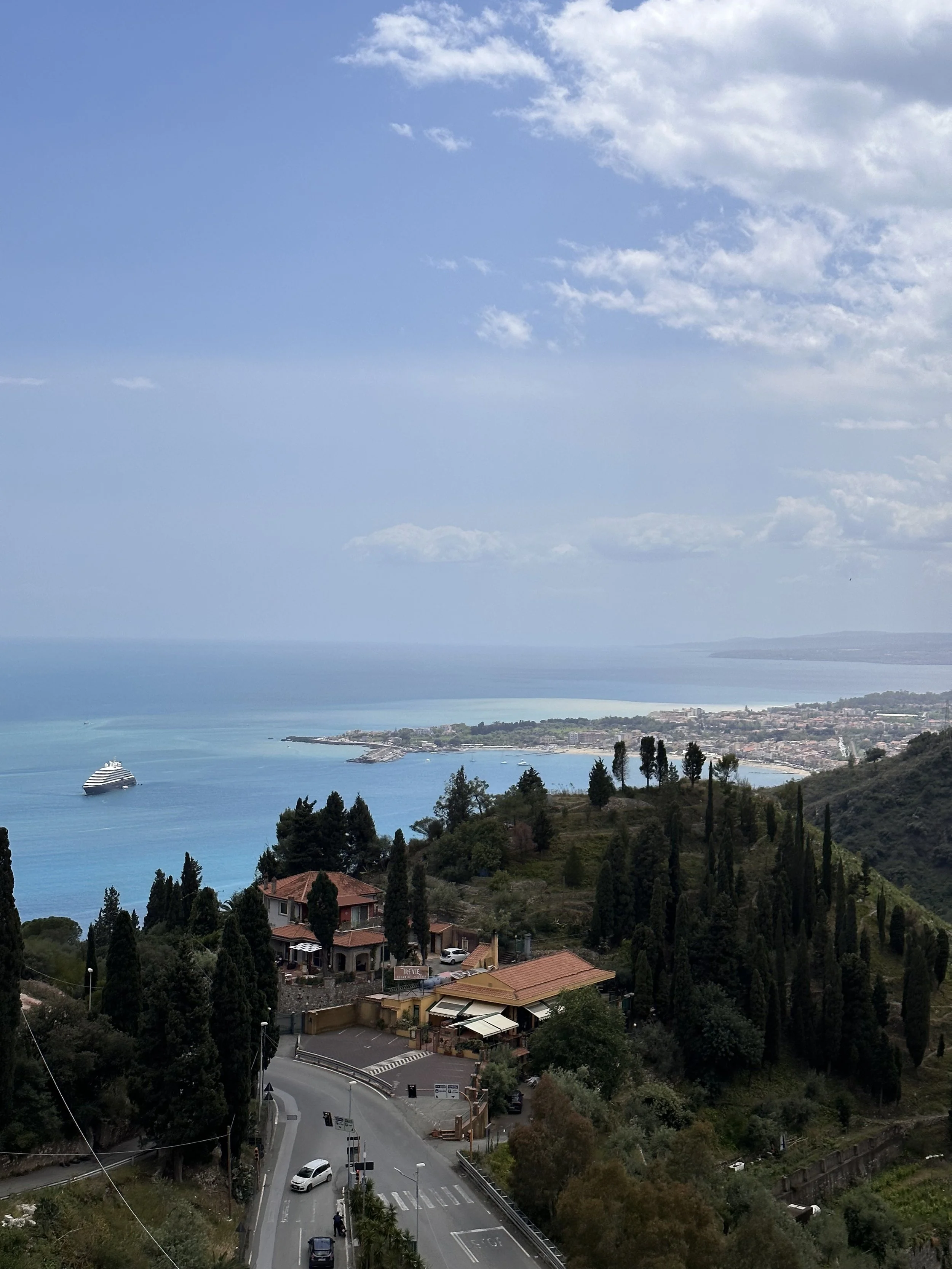
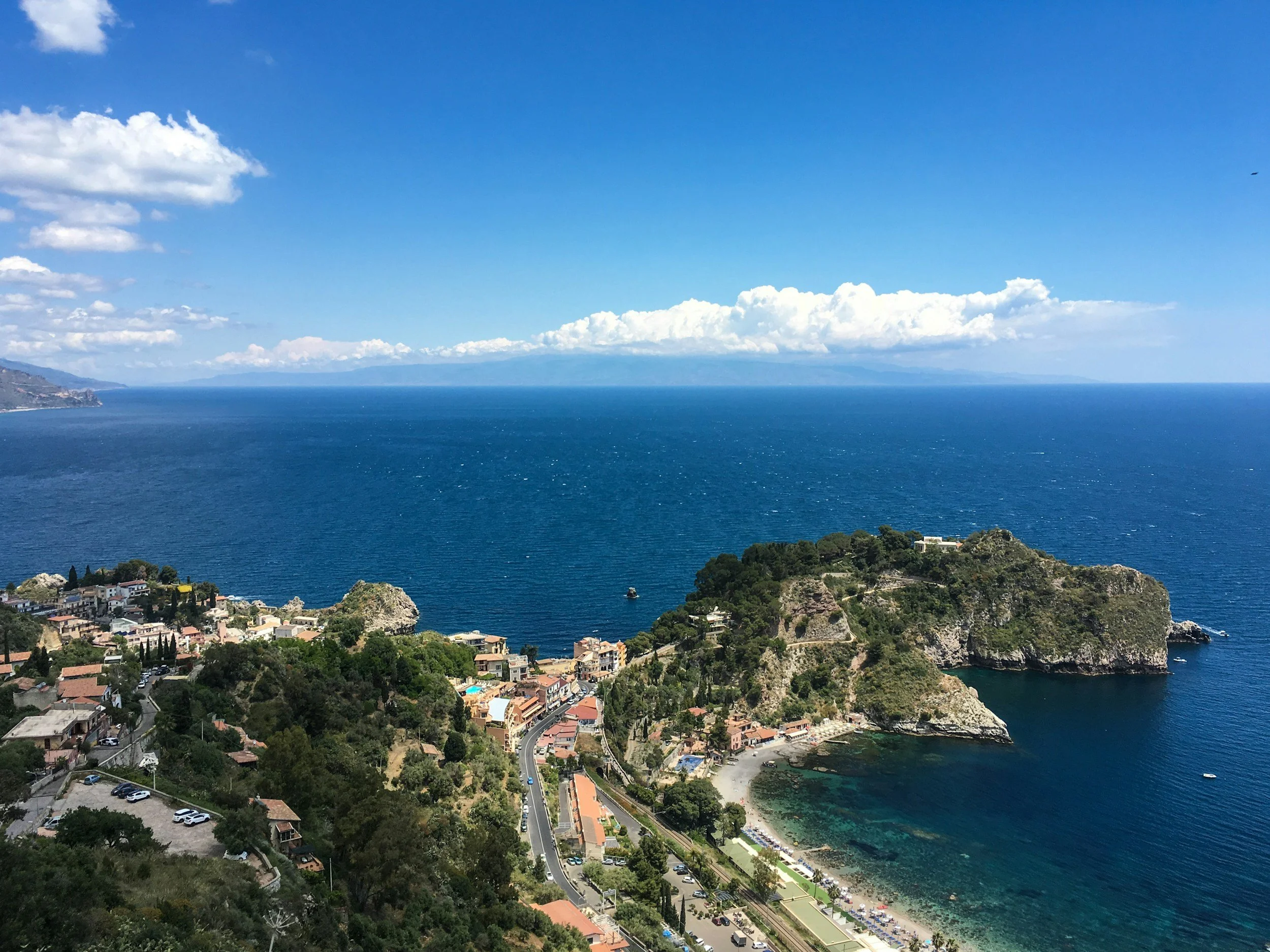
But then you arrive, and by the time we did the clouds from Etna had burned off into a sunny afternoon along the coast. The views from Taormina are exactly what you picture when you imagine the Italian coast. Not approximately. Exactly. The town sits on a hillside above the sea, and the water and the coastline spread out below in a way that looks almost unreasonably perfect. After the bare landscape of Etna, it was a complete reversal, all color and warmth and Mediterranean light.
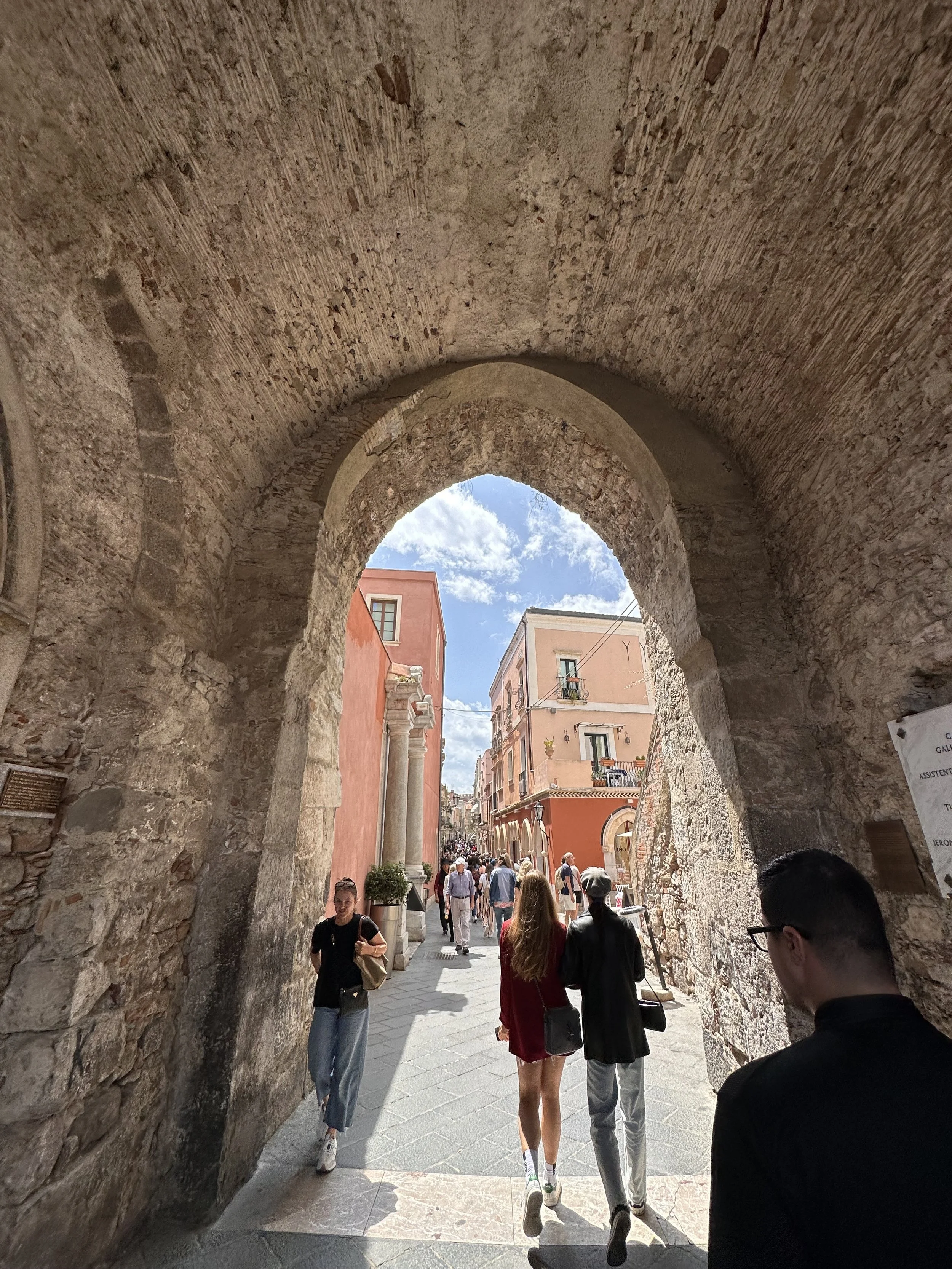
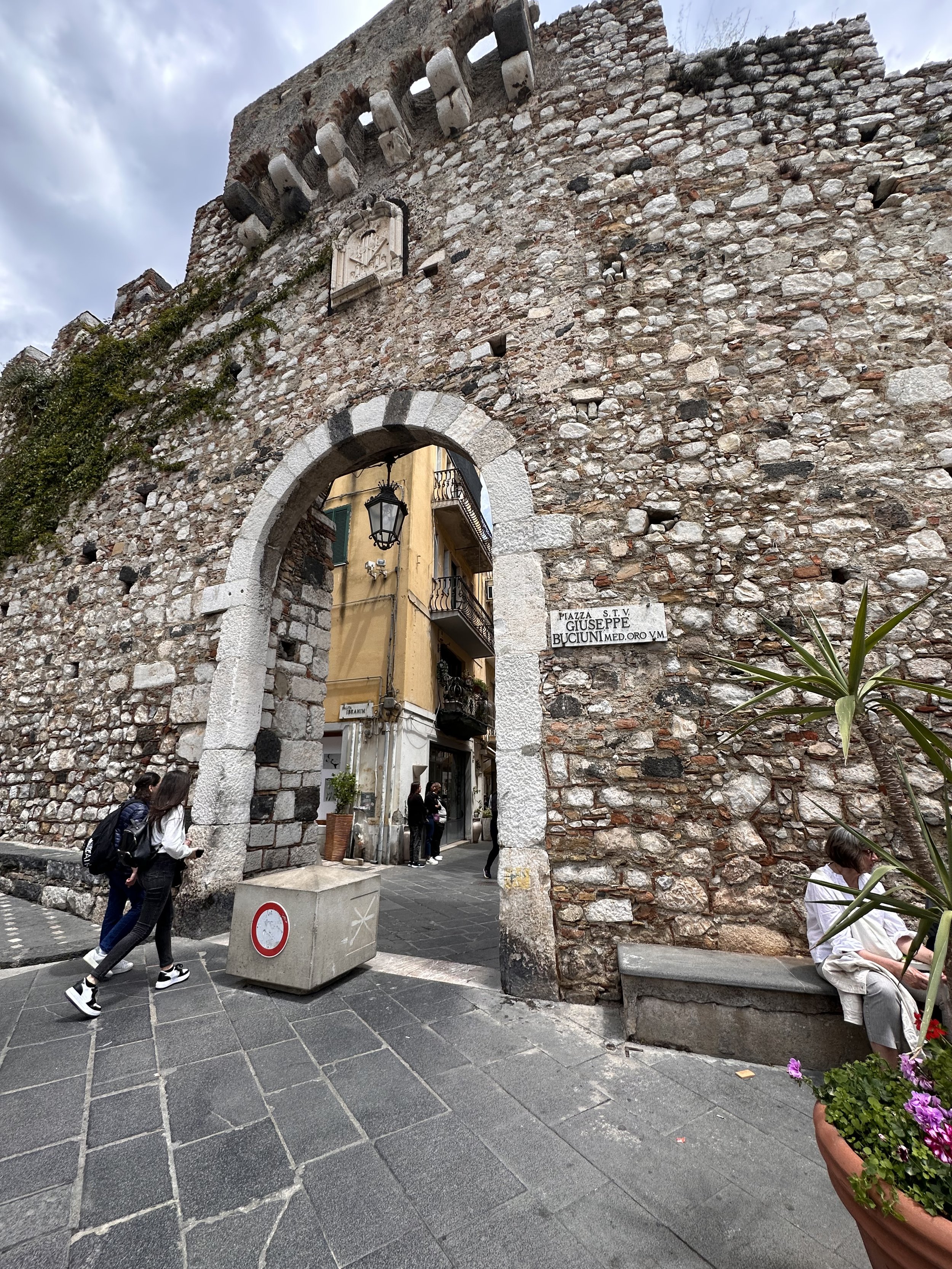
The town itself rewards an unhurried wander. The streets are narrow and old, lined with shops and cafés, and you could easily spend your whole time here just walking them. The Duomo di Taormina, the town's cathedral, is pretty from the outside, nothing overwhelming but worth a look as you pass. With only an hour and a half here, which is what the cruise tour gives you, you will not see all of it. You will see enough to understand why people build whole trips around this one town.
One honest regret: with only ninety minutes, we completely missed the Greek Theatre of Taormina, the ancient amphitheater built into the hillside with Mount Etna framed behind the stage. It is the single most famous sight in the town and the thing most people come for, and we ran out of time before we got to it. If you have any say over your schedule here, prioritize it over the shops and the wandering we did instead. Learn from our mistake.
If You Have More Time
A half day out of Messina shows you two slivers of Sicily, and it is worth saying plainly that the island holds far more than Etna and Taormina. Sicily is enormous, and the parts we did not reach are some of the most celebrated in the entire Mediterranean.
If you can give Sicily real time, Syracuse and its island old town of Ortigia are often called the most beautiful corner of the island, layered with ancient Greek history. The Valley of the Temples at Agrigento holds some of the best-preserved Greek temples anywhere in the world, better in some respects than what survives in Greece itself. Palermo, the capital, is chaotic and layered and full of markets and Arab-Norman architecture unlike anywhere else in Italy. And Cefalù is the postcard beach town if that is what you are after.
We saw Sicily the way a cruise lets you see it, which is to say barely. Take our day as a taste, not a verdict. This is an island that rewards a full trip of its own.
Getting To Sicily
Sicily from a cruise is a day of long drives bookending short stops, so understanding the logistics helps you set expectations before you go.
Coming from a Cruise Ship
Ships dock in Messina, on the northeastern tip of the island, directly across the strait from the mainland. Messina is not really the destination itself. It is the gateway, and almost every shore excursion uses it as a starting point to reach the things people actually come to this part of Sicily for. The two big ones are Mount Etna, roughly an hour and a half to two hours south by road, and Taormina, about 45 minutes down the coast.
We did a cruise excursion that combined both, Etna and Taormina, in a single day. It is the most efficient way to see the two headline sights without organizing anything yourself, and transport and a guide are handled. The tradeoff is real driving time and not much room to linger. We got about 90 minutes in Taormina, which goes fast.
If you would rather go independently, taxis and private drivers are available at the Messina port, and a private tour gives you more time at each stop and a smaller group. For a day this driving-heavy, that flexibility is worth considering. Just confirm your return time and build in a buffer, because the ship will not wait, and the traffic getting into Taormina in particular can be slow.
If you are not on a cruise, Sicily is a place to give real time rather than a day. Catania is the closest major airport to Etna and Taormina, well under an hour from both, and a far more practical base than Messina for exploring this side of the island. Trains and buses connect the coastal towns, and renting a car opens up the interior and the rest of Sicily, which deserves far more than the sliver a cruise day allows.
Coming Independently
One Thing Worth Knowing
The drive from Messina to Etna climbs from sea level to around 6,000 feet, and the weather at the top is often completely different from the coast. We left a gray, cloudy port and found wind and low cloud on the volcano, then descended into a sunny afternoon in Taormina. Dress in layers you can adjust, because you may experience three different climates in one day.
Let me start with my own mistake. I wore white shoes to Mount Etna. The same white shoes I had worn all over the rest of Italy, where they were fine. On a volcano, where the ground is black volcanic rock and ash, they were a genuinely dumb choice, and they did not recover. Learn from that. This is a day where what you wear matters more than usual, because you are dressing for a 6,000 foot volcano and a seaside town in the same afternoon.
What to Pack for Your First Trip to Mt. Etna and Taormina
Weather (Quick Reality Check)
We went in May. The coast was mild and turned sunny by the time we reached Taormina, but Etna was windy and cold and wrapped in low cloud. That gap between sea level and the summit is the whole challenge of packing for this day. Summer makes the coast and Taormina hot, but Etna stays cooler and exposed at altitude no matter the season. Whatever the forecast says for Sicily, the volcano will be colder and windier than that.
Core Items for Mt. Etna & Taormina
Closed-toe shoes you do not care about, with grip. The volcanic terrain at the Silvestri Craters is loose, dark, uneven rock that will scuff and stain anything light colored. Wear something sturdy and forget about fashion for this one. Save the nice shoes for Taormina, where they will actually fit in.
A warm layer and a windbreaker for Etna. At 6,000 feet the wind cuts and there is no shelter. Something that blocks wind matters more than something heavy. You will likely take it off the moment you are back down on the coast.
Layers you can strip down to for Taormina. Under the volcano layer, dress for the warm, sunny coastal town you will be in by afternoon. The whole day is an exercise in adding and removing layers.
Sunglasses and sunscreen. The sun on the coast and the glare off the volcanic landscape are both stronger than the gray morning might suggest.
A crossbody bag that zips. Taormina gets crowded and narrow, especially in peak season, and it is standard sense for any busy tourist town.
A portable charger. Between the stark volcano landscape and the postcard coast, you will take more photos than you expect across a long day.
One Note on the Altitude
The Silvestri Craters sit at around 6,000 feet, and the tour involves walking uphill on uneven terrain to reach them. It is not a hard hike, but the altitude and the wind make it more demanding than a flat stroll, and there are no restrooms up there. If you have heart or blood pressure concerns, this is worth factoring in, as the tour operators themselves flag it. For everyone else, just go in knowing it is a real walk in thin, cold air, not a stroll to a viewpoint.
Where to Eat & Drink on Your First Trip to Sicily
A cruise day in Sicily does not give you much room for real meals, so this is less a restaurant guide than an honest account of what we actually ate between the volcano and the coast, and what you should seek out if you get the chance.
The tour included a stop for a Sicilian cannoli at a mountain restaurant on the way up Etna, Ristorante Cantoniera, where we also used the bathroom and grabbed a hot chocolate and a snack. I will be honest: it was all mid. The cannoli was fine, the hot chocolate was fine, none of it was the cannoli revelation the itinerary implied. This is the nature of a stop built into a tour for logistics rather than for the food. Eat it, use the restroom, and save your real cannoli hopes for somewhere that is not primarily a bus stop on a volcano.
The Cannoli on the Mountain
Taormina, and the Best Thing I Ate All Day
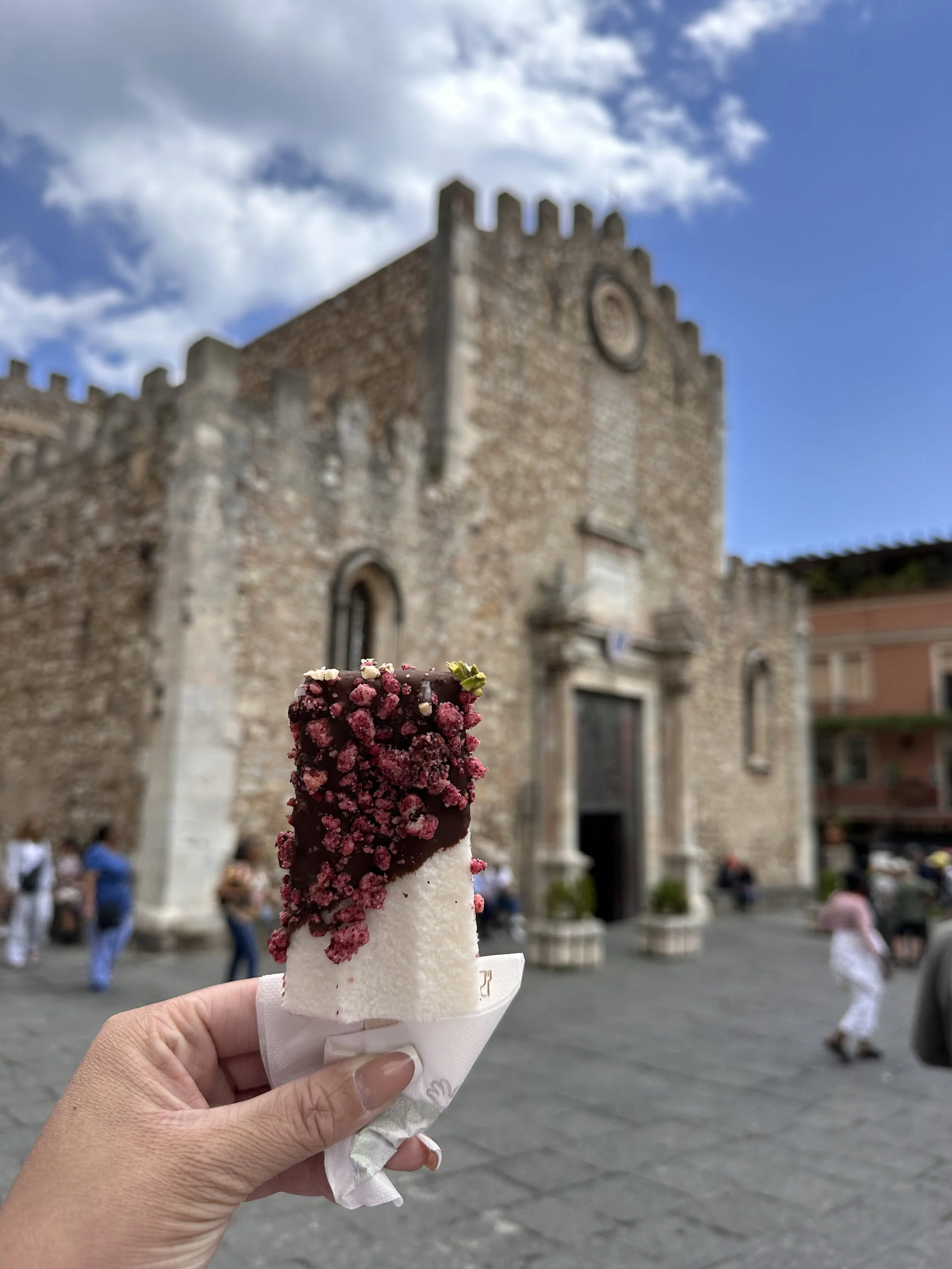
The standout of the day was something small and unexpected. Walking through Taormina, I got a coconut popsicle dipped in chocolate with a raspberry crumble on the outside. It was genuinely one of the best things I ate in Sicily, the kind of simple, perfect thing you stumble into when you are just wandering a town with no plan. Taormina is full of gelaterias, pastry shops, and cafés, and with only 90 minutes there we did not sit down for a proper meal. If you have more time, this is where you would want to eat, somewhere along the narrow streets with a view of the coast.
Birra Messina
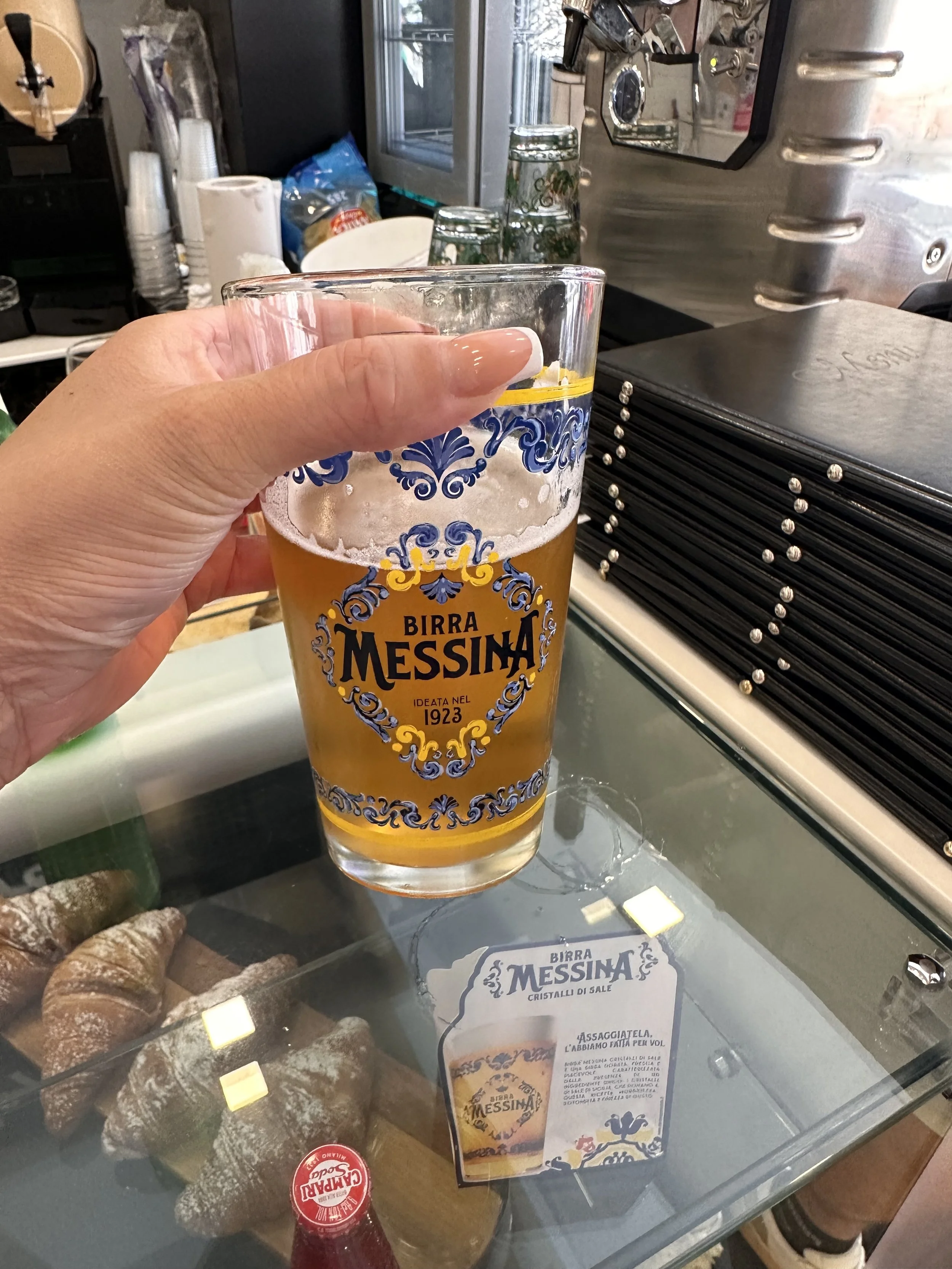
Here is the detail I loved most. In Taormina we tried Birra Messina, the local beer, and it was so good. Crisp, light, exactly right for a sunny afternoon on the coast. What makes it better is the story. Birra Messina was founded in 1923 in Messina, the very city our ship had docked in that morning. So the beer that capped off the day came from the place the whole day started. The brand has a genuinely good history too, revived in 2013 by a group of former brewery workers who refused to let it disappear. Order one in the afternoon sun and toast the city that brought you in.
What to Try in Sicily
We barely scratched the surface of Sicilian food, which is some of the most distinctive in all of Italy, shaped by Greek, Arab, and Norman influences over centuries. If you have more time than a cruise day, seek these out.
Cannoli, done properly, with the shell filled fresh so it stays crisp. The mass-produced version sitting pre-filled in a case is not the real thing. Find a pastry shop that fills them to order.
Arancini, the fried stuffed rice balls that are Sicily's great street food, crisp outside and savory inside.
Granita, especially in the warmer months, the semi-frozen dessert often eaten with a brioche for breakfast, a Sicilian original.
Anything with pistachio, particularly from the Bronte region near Etna, where the pistachios are famous across Italy.
And the seafood, given that you are on an island in the middle of the Mediterranean. The simplest preparations, as everywhere in Italy, tend to be the best.
You Have to Earn the Blue
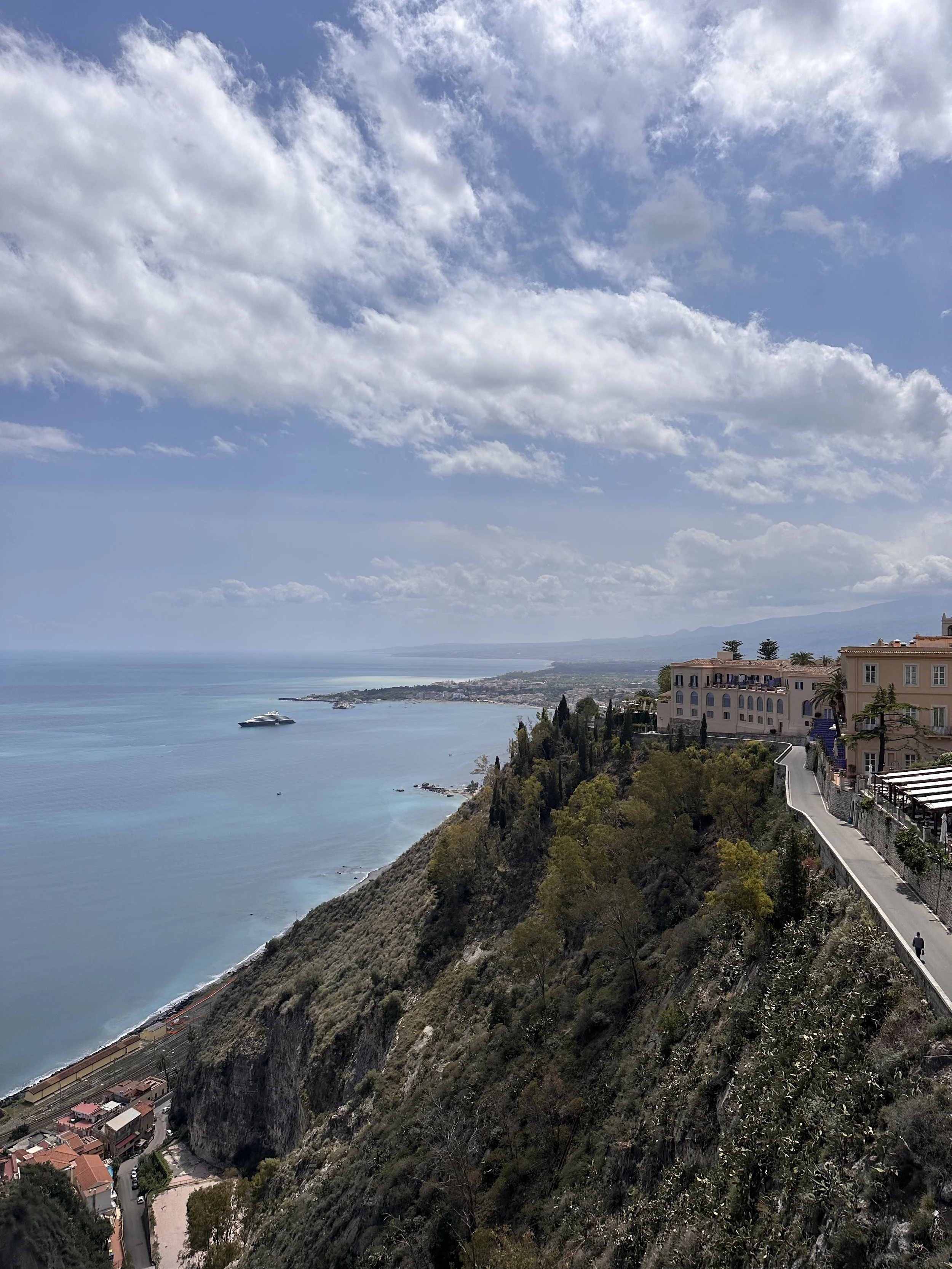
In the morning I stood on black ground under a gray sky, cold wind cutting across a landscape that looked scorched and dead, and felt a little let down. By the afternoon I was looking at the bluest water I had ever seen, in a town so beautiful it looked staged. Same island. Same few hours. I did not change. The ground did.
I keep coming back to how close together those two things were.
You could drive the road between them in under an hour, and yet they belong to different planets. Etna is bare and brutal and the color of ash. Taormina is all warmth and color and Mediterranean light. Standing in one, you would never believe the other was a short drive away. And the strange part is that I do not think I would have felt Taormina as intensely as I did if I had not spent the morning somewhere so stripped down and severe.
That is the thing I did not expect Sicily to teach me on a rushed day off a cruise ship. The volcano I was lukewarm about was not a waste. It was the setup. Coming down off that bare black mountain and arriving at the coast, the blue hit harder, the sun felt warmer, the whole postcard landed with a force it never would have if I had simply been dropped there straight off the ship. The disappointment of the morning was doing quiet work the entire time.
I think a lot of travel is like that, and a lot of life is too. You do not always get to feel the good part fully until you have stood somewhere harder first. The black ground is not the part you came for. But you might need it to see the blue the way it deserves to be seen.
So if your day starts on the volcano and you find yourself underwhelmed, the way I did, hold on. You are not at the disappointing part of the trip. You are at the part that makes the next part land.
Itinerary for Your First
Trip to Sicily
A Sicily cruise day is heavy on driving and light on time at each stop, so the schedule mostly runs itself once you are on the bus. Plan for around eight hours from leaving the ship to returning, most of it split between two long drives and two short visits. Here is how the day actually unfolds.
Morning: Messina and the Drive Up Etna
You disembark in Messina, and almost immediately you are on the road south toward the volcano. The drive is long, an hour and a half to two hours, and ours felt rushed, winding up through countryside and villages before the landscape turns stark and volcanic. Use the time to rest. You will want the energy later.
Most tours make a brief stop at a mountain restaurant on the way up, in our case Ristorante Cantoniera, for the bathroom, a coffee or hot chocolate, and the Sicilian cannoli the itinerary promises. Set your expectations low here. It is a functional stop, not a culinary one.
Late Morning: The Silvestri Craters
You arrive at the Silvestri Craters at around 6,000 feet and set off on foot. The walk up to the crater rim is uneven and exposed, and at altitude with the wind it asks a little more of you than a flat stroll. The ground is black volcanic rock, the wind is constant and cold, and the landscape is stark in a way that is more lunar than the smoking volcano you might be picturing. Walk the rim, take in the contrast of the black ground against the sky, and give yourself the full time here even if it underwhelms at first. It grows on you the longer you stand in it.
Midday: The Drive to Taormina
Back on the bus and down toward the coast, about 45 minutes, though the approach into Taormina can back up badly. There is a narrow two-way stretch where tour buses cannot pass oncoming cars easily, and the traffic crawls. Be patient. The payoff is worth the wait.
Afternoon: Taormina
You get around 90 minutes here, which goes fast, so be deliberate about it. The views over the coast are the reason everyone comes, and they deliver completely. If you do one thing with intention, make it the Greek Theatre, the ancient amphitheater with Etna framed behind the stage, which we ran out of time for and regretted. After that, wander the narrow old streets, look at the Duomo from the outside, and pick up something to eat. A coconut popsicle, a granita, and a cold Birra Messina in the sun are all the right call. Ninety minutes is not enough, and you will leave wishing you had the rest of the afternoon.
Late Afternoon: Back to the Ship
The drive back to Messina is another stretch of road, so leave Taormina with a comfortable buffer. The ship will not wait, and a day this dependent on traffic is not one to cut close. Get back to the port with time to spare, head up on deck, and watch Sicily slide past as you sail out of the strait you arrived through that morning.